Math games for kids can help children not only get better grades at school but also develop a critical reasoning. Math games have many benefits. Firstly, they can help kids become good at maths. Secondly, they can also help kids develop problem solving skills and collect and analyze data.
Logic games that help kids develop problem solving skills
Logic puzzle games are among our most recommended logic games. Logic puzzles can sharpen kids problem solving skills and also test their math skills. Two logic puzzle games that we recommend are the Sudoku and Kakuro puzzles. You guessed it, they are Japanese, and the Japanese are good when it comes to math and logic.
Sudoku is an extremely popular puzzle game. New Scientist even wrote an article about the game demonstrating how it can make you smarter along with listening to classical music, getting exercise and eating healthy. In fact, Sudoku puzzle games can help stimulate brain activity and increase IQ. That's probably the reason why teachers around the world consider them great math games for kids and have even started giving these puzzles to students! Overall, Sudoku is an excellent way for kids to develop logical thinking skills.
There are many kinds of Sudoku games that you can get. There are even Sudoku books for all ages and Sudoku video games. Make sure that you pick a Sudoku game that is appropriate for your kid's age as some Sudoku games can become extremely challenging. We also recommend a website called Sudoku Essentials, if you are looking for more information and advice on sudoku for kids.
Kakuro puzzles can test kids addition, multiplication and math skills. They are also among the math games for kids that we recommend. One good kakuro puzzle board game is The Kakuro by Specialty Board Games. This game combines simple math with the strategy of crossword puzzles. It also sharpens logical thinking skills.
Αnother logic game is chess. And there are chess sets especially designed for beginners that you can get. Finally, for younger children, we recommend tic-tac-toe, another great logic game!
Find here our selection of chess games including a chess game for beginners and a classic chess set.
Board games to practice math
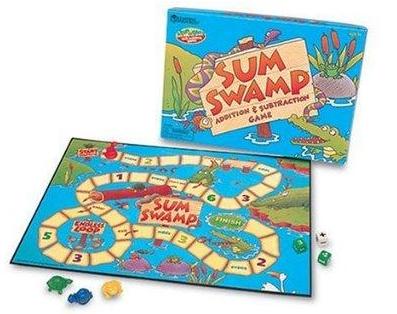
Board games can also be fun math games for kids and a nice way for family and friends to spend time together. There are board games that make kids practice counting and run additions, subtractions and even multiplications without realizing it (for example: Chutes and Ladders, Trouble, the Sorry Board Game). Don't be surprised if you also develop a passion for one of these games!
Counting money games such as Monopoly are also a lot of fun and by counting money, kids also improve their math skills. Another added benefit of monopoly is that it introduces the concepts of investing and saving.
All about the classic Monopoly game and the Monopoly Junior edition.
Sensible Math Education
Written by a 20-year math educator, the Sensible Math Education website offers free printable math worksheets, at-home math activity ideas and lots of math curriculum guidance to help kids be more successful in math class.
Card games and dice games that boost math
Card games are simple because you can get a simple deck of cards and apply the rules of certain games. Traditional games that we recommend are: Go Fish, Spoons, Old Maid, Snap. The internet has loads of resources describing the rules of these games. Math 24 is another of the math games for kids that we like. Math 24 is designed for students in grades 3 to 5. Players practice basic mathematics facts, mental math and develop problem solving skills. And they do this all while having fun. This game definitely has the potential to improve the math scores of a kid struggling with numbers.
Dice games are one of the oldest kinds of games, dating back to the Roman times! They can help children as well as adults develop math skills. There are dice games in the form of math games for kids that are based on luck and strategy. By counting and adding numbers, and running quick calculations, players become better at math.
Dice games for younger children are mostly based on luck, while games for older children tend to be based on strategy and thinking. Dice games are also practical when you travel. They are also easy to ship if you want to send them as a gift to another state or country. And most of all they are cheap!
There are a few dice games that we recommend: Yahtzee, Bunco, Farkle and Phase 10 Dice Games. Yahtzee (ages 8-12) is a classic dice game that combines math and strategy. Children practice addition and multiplication and practice critical thinking skills. Another advantage of this dice game is that it usually retails at around $10.
Bunco (ages 10 and up) is a dice game based entirely on chance that makes players practice addition and subtraction facts. The object of the game is to roll certain combinations of dice and collect points. By the way, you can easily find this game at any department store or buy it online.
The Phase 10 Dice Game by Fundex Games is a fun dice game designed for children ages 10 and above. It is one of the math games for kids that helps children practice addition and multiplication facts and that also requires strategy.